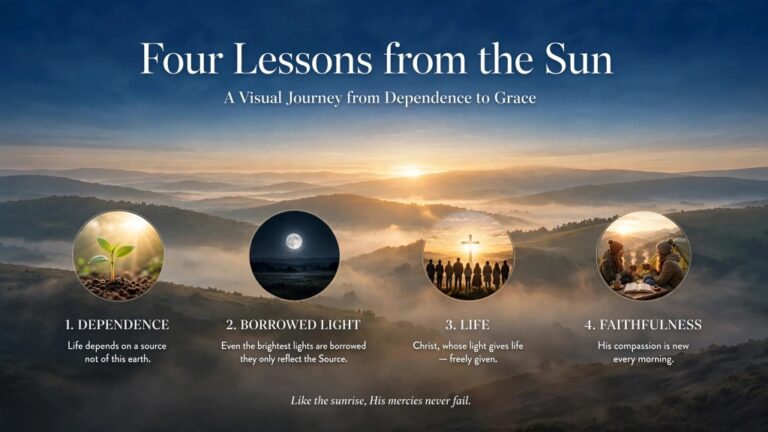
Light is the Bible’s favorite metaphor for God — and the first thing God ever created. From sunrise to photosynthesis, sunlight preaches every day about dependence, revelation, guidance, and hope.
Here are 25 sermon illustrations from the sun and sunlight that connect what we see in creation to what Scripture says about Christ, our true Light
1. The Sun That Sustains Life – A Source Not of This Earth
Nature illustration
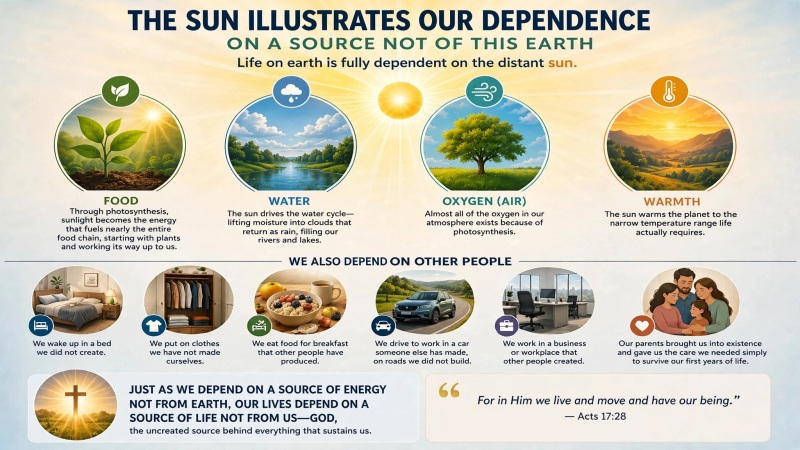
Life on earth depends on something that is not of the earth: the sun. Solar energy drives photosynthesis in plants, powers the water cycle, shapes our atmosphere, and provides warmth. Without this heavenly source, ecosystems would collapse. The sun is not part of earth’s system, yet earth’s life is utterly dependent on it. In this way, life on earth is sustained by a source that is fundamentally other than the earth itself.
Human illustration
But we also depend on each other. The bed we sleep in, the food we eat, the clothes we wear, the car we drive, the company we work for, the apps we use—none of us create these alone. Our daily life is woven from countless gifts and labors of other people, many of whom we will never meet. We live in a vast web of mutual dependence.
Spiritual truth
This double dependence points to a deeper reality. Just as the sun—a source not of this earth—sustains physical life, and just as we depend on other people for almost everything we use, so God, who is not of this world, sustains our physical and spiritual life moment by moment.
All human interdependence is a mirror of our ultimate dependence on God. Every hand that serves us is, in a hidden way, an instrument of the One in whom “we live and move and have our being.” In Christ, this truth becomes personal: He is the “light of the world” and the source of eternal life, a life that comes from above, not from below.
Bible text
Acts 17:28 – “For in Him we live and move and have our being.”
Related texts: Colossians 1:16–17; Hebrews 1:3; John 8:12; John 3:31; 1 Corinthians 12:12–27
Sermon takeaway
We depend on a Source not of this earth (the sun / God), and we depend on each other for almost everything in daily life. Both realities teach us the same lesson: we are not self-sufficient. Life flourishes when we acknowledge our deep dependence—on one another, and ultimately on God, who holds all things together and works through human hands to care for us.
Reflection
Where can I become more aware of my dependence today?
– On God: by pausing in sunlight, before meals, or in prayer, and thanking Him as the Source of all life.
– On others: by noticing one thing I use or enjoy today (food, transport, digital tools, work) and consciously thanking God for the people behind it, and perhaps thanking one of them directly.
2. Borrowed Light – Real Light, But Not Its Own
Nature illustration
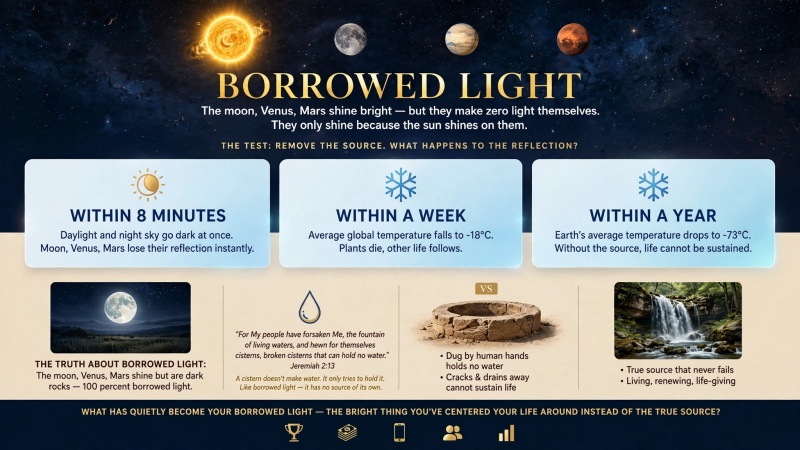
The moon can light up a whole field at night. Venus shines so bright we call it the Morning Star. But none of them make their own light. Their light is real — you can see by it — but it is borrowed. It is reflected light with no source in itself. It only shines because the sun shines on it. If the sun disappeared, the moon would go dark in about eight minutes, the time it takes light to reach us.
Human illustration
We live by borrowed light too. A relationship, money, success, health, even ministry — these are real lights that give real joy. But they are not independent. They only shine because they have been lit by another Source. For a while we treat the reflection as the source, and it works, until the source shifts.
Spiritual truth
Borrowed light is still light, but it cannot sustain itself. It is real, but dependent. God is the Fountain — the Source with light and life in Himself. John the Baptist was a true lamp, but not the Light; Jesus is the true Light with light in Himself. Everything else is reflected light — good as a gift, fatal as a foundation. That is Jeremiah’s warning: we forsake the Fountain and build on cisterns that can hold borrowed water, but have no spring in themselves.
Bible text
Jeremiah 2:13 – “…forsaken Me, the fountain of living waters, and hewn… broken cisterns that can hold no water.”
Related texts: John 1:4, 8-9; John 5:35; Psalm 36:9; John 8:12
Sermon takeaway
Borrowed light is real light, but it only shines while turned toward the Source. Build your life not on the reflection, but on the Fountain Himself.
Reflection
What is your borrowed light — the real but dependent light you’ve been treating as if it were independent? Name it today, thank God for it as a gift, and pray: “You are my fountain, this is only a reflection.”
3. The Sunflower – Four valuable life lessons
Nature illustration
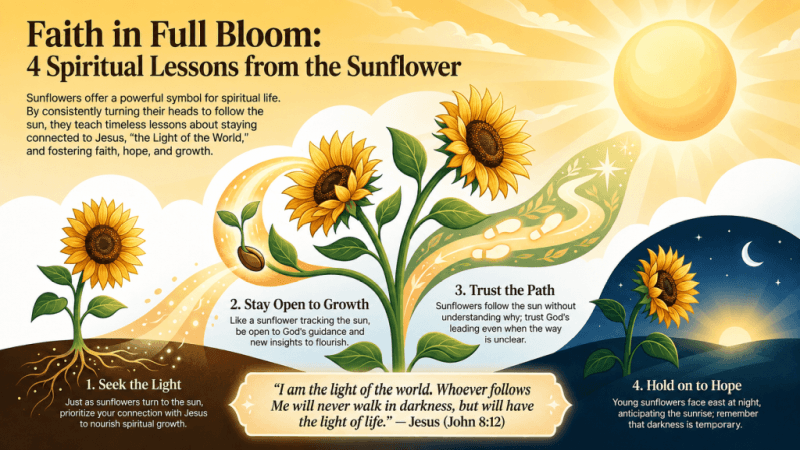
Young sunflower plants follow the sun across the sky, from sunrise to sunset. At sunset, the young sunflower plant turns back, facing east, anticipating the sunrise.
Four lessons from its turning
- Connection with the Light of the World. The sunflower’s turning isn’t a choice made once — it’s a built-in orientation toward the one thing it cannot grow without. We were made with a similar pull toward Christ, but ours doesn’t run automatically; it has to be tended, or it quietly fades.
- Openness to growth and change. The plant doesn’t lock into one angle at sunrise and stay there — it keeps adjusting as the sun moves, degree by degree, all day. Faith works the same way: the posture that got us started rarely carries us all the way through.
- Trust without full understanding. The sunflower has no way of knowing where the sun will be an hour from now. It simply responds to the light it senses in the moment. Trust isn’t the absence of confusion — it’s continuing to turn even while we can’t see the whole picture.
- Hope in times of darkness. Before night falls, the plant is already reoriented east — facing a sunrise that hasn’t come yet. That’s hope as a posture, not a feeling.
Bible text
John 8:12 – “Whoever follows Me will never walk in darkness, but will have the light of life.”
Sermon takeaway
The sunflower teaches us four lessons: stay connected to the Light of the World. Stay open to growth. Trust the path, even when you can’t see it. And be hopeful in times of darkness — whether a dark season in life, or life’s evening.
Reflection
What has my attention been bending toward lately — and is it Christ?
For a deeper look at this lesson, see Biblical Meaning of the Sunflower: 4 Spiritual Lessons.
4. The Sun Symbolizes Christ, Who “Shines” on Everyone
Nature illustration
The sun makes no distinctions. Jesus said it Himself: the Father “causes His sun to rise on the evil and the good, and sends rain on the righteous and the unrighteous.” The sun doesn’t rise on the good first and the bad later. It rises on both at once. No one earns it, no one is excluded from its reach — it sustains the life of whoever simply stands in it.
Human illustration
We sometimes think who is worthy of kindness and who isn’t, who is close enough to God and who is too far. But that is not how sunlight works, and it is not how God works. You don’t have to prove you are worthy to stand in the sun. You just have to be willing to stand in it. The offer is already overhead.
Spiritual truth
What the Father does in creation with the sun, He does in redemption with His Son. Jesus didn’t just call Himself light poetically — He tied His light directly to life itself: “I am the light of the world. Whoever follows Me will never walk in darkness, but will have the light of life.” Just as the sun sustains physical life for anyone under it, Christ offers unending life — not measured in years, but eternity — to anyone who steps into it. Like sunlight, it is not earned. It is given.
Bible text
Matthew 5:45 – “He causes His sun to rise on the evil and the good, and sends rain on the righteous and the unrighteous.”
Related texts: John 8:12 – “I am the light of the world. Whoever follows Me will have the light of life.” ; John 3:16 – “whoever believes in Him should not perish but have eternal life.”
Sermon takeaway
Like sunlight, grace doesn’t check credentials before it rises — it is offered to whoever will receive it. It is not a wage to be earned, but a light to be stepped into.
Reflection
Is there anyone in your life you’ve assumed is “too far” from that offer to reach? Pray for them by name today — family, neighbor, coworker — as someone already standing under the same sun, already within reach of the same grace.

5. The Sun Symbolizes God’s Faithfulness, Renewed Every Morning
Nature illustration
Human eyes perceive only a small portion of the sun’s light spectrum — a narrow band of visible light. Ultraviolet and infrared exist and influence life, though unseen. Ultraviolet enables Vitamin D and supports bone and immune health. Infrared provides warmth and supports life. The sun doesn’t only send what we can see — all of it reaches Earth and works for our good, even the parts we cannot detect.
Human illustration
We live as if what we can understand is all there is. If we can’t see how God is working, we assume He isn’t working. We let our limited visible spectrum convince us the invisible doesn’t exist. But just because we can’t see it doesn’t mean it isn’t there, sustaining us.
Spiritual truth
Scripture points to that same vastness beyond our perception as a picture of who God is. Likewise, God has not revealed everything about Himself. His thoughts and ways extend far beyond human comprehension. What He has shown us is enough to trust Him; what remains hidden is enough to humble us.
Bible text
Isaiah 55:8 – “For My thoughts are not your thoughts, neither are your ways My ways, declares the Lord.”
Sermon takeaway
Faith does not require full understanding — only trust in God who knows what we cannot see. All of His ways work for good, whether we can currently see them or not.
Reflection
How can I rest in what God has revealed, while trusting Him with what remains hidden?

Article: 4 Spiritual Lessons From the Sun
6. The Invisible Spectrum – God’s Unsearchable Wisdom
Nature Illustration:
Human eyes perceive only a small portion of the sun’s light spectrum — a narrow band of visible light, about 400 to 700 nanometers. It’s the only part our eyes were made to detect. But beyond that visible band is ultraviolet. We can’t see it, yet it exists and reaches us, unseen. And below that visible band is infrared. We can’t see it either, yet it exists and reaches us, unseen. The sun doesn’t only send what we can see. Much of its light is invisible to us, yet still real and still present — just beyond our perception.
Human illustration
We live as if what we can see and understand is all there is. If we can’t see how God is working, we assume He isn’t working. We let our visible spectrum convince us the invisible doesn’t exist. But limited perception doesn’t mean limited reality.
Spiritual truth
Likewise, God has not revealed everything about Himself. His thoughts and ways extend far beyond human comprehension. What we grasp is only a fraction of who He is. Much remains unrevealed.
Bible text
Isaiah 55:8 – “For My thoughts are not your thoughts, neither are your ways My ways, declares the Lord.”
Sermon takeaway
Faith does not require full understanding — only trust in God who is larger than what we can see.
Reflection
How can I rest in what God has revealed, while trusting Him with what remains hidden?

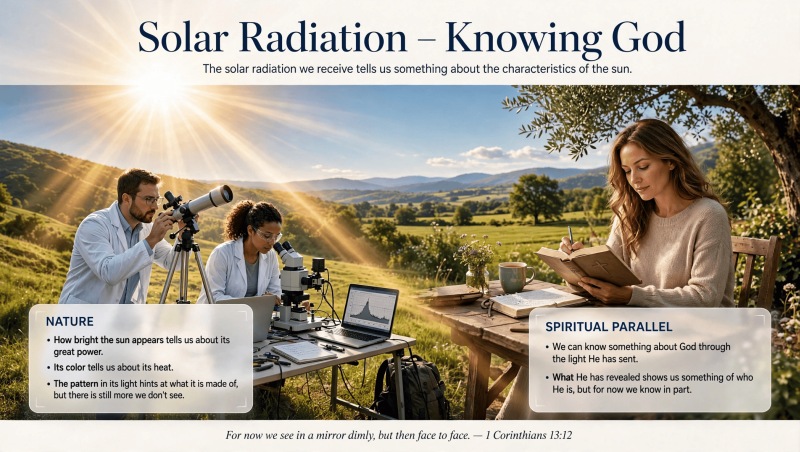
7. Light Reveals the Sun – God’s Light Reveals Who He Is
Nature illustration
The sunlight we see tells us something about the characteristics of the sun. The sun is not burning like wood on a fire. Deep inside it, chemical reactions are taking place that causes the solar radiation. Without ever going there, scientists have learned from that light what the sun is like — mostly hydrogen and helium, with a little of other elements mixed in. We have never been inside the sun, but the light that reaches us allows us to truly know something real about it, even if not everything.
Spiritual truth
Through what God has revealed to humanity, we can come to know Him — though only in part. What He has shown us is true and enough to trust, even if there is so much more we have not yet seen.
Bible text
1 Corinthians 13:12 – “For now we see in a mirror dimly, but then face to face.”
Sermon takeaway
We can begin to understand God through His revelation to humans. However our knowledge of God is limited — until the day of full understanding.
Reflection
What has God already revealed about Himself that I can meditate on today, even while much remains unrevealed?
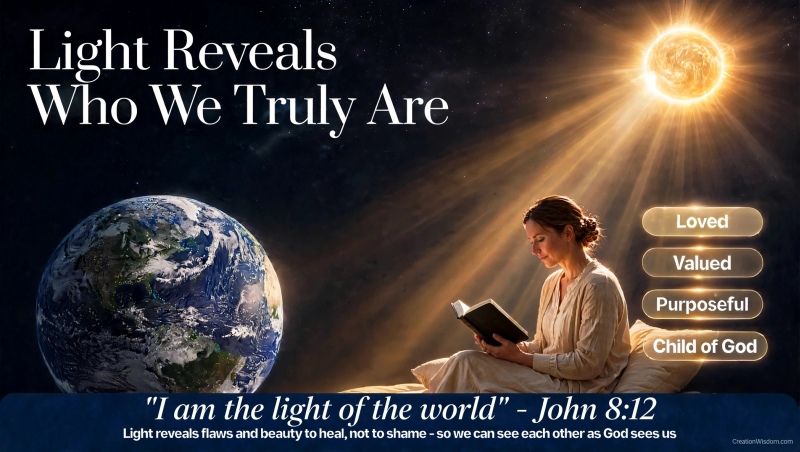
8. Light Reveals Who We Truly Are
Nature illustration
Sunlight does two things at once. The light that comes from the sun tells us something about the sun itself. But that same sunlight, when it hits the earth, reveals the world as it truly is — helping us navigate, and helping us see who we truly are, and how to see each other. Light does not create what is here on earth – it reveals what is already here.
Human illustration
Have you ever seen dust in your house only when the sun streams through the window? The dust was there all along – the light just made it visible. Or think of looking in a mirror in a dim bathroom versus in bright daylight. In dim light we can imagine we are fine. In clear light we see both the tiredness and the real beauty. We need light not only to see where we are going, but to see who we are.
Spiritual truth
Jesus said, “I am the light of the world.” As the Light, He does two things. First, He reveals who God is – like sunlight reveals the sun. Second, He reveals who we truly are – like sunlight reveals the world. In His light we see our flaws, not to shame us, but to heal us. We also see our true value and purpose – that we are seen, known, loved, and made to live in His light. Without His light, we walk in darkness and guess who we are. In His light we stop pretending and start living in the light of life. We also learn that we do well to see not just ourselves, but each other through God’s light.
Bible text
John 8:12 – “I am the light of the world. Whoever follows Me will never walk in darkness, but will have the light of life.”
Related texts: Ephesians 5:13 – “Everything exposed by the light becomes visible.”; Psalm 36:9 – “In Your light we see light.”; John 3:21
Sermon takeaway
Jesus’ light reveals who God is, who we truly are, and how to truly see each other — not to shame us, but to heal us and bring us into His purpose. Let us see the world and each other through God’s light.
Reflection
How does the light of Christ help me see the world more clearly? What does it reveal about who I am – my flaws and my value – and how can I live more fully in His purpose today?
9. Light Bulb Sermon Illustration – Plugged Into the Source
Nature illustration
A light bulb contains everything needed to shine – filament, glass, wiring. But unplugged, it stays dark. It has potential, but no power in itself. The moment it is screwed into the socket and connected to electricity, it fulfills its purpose and shines.
Human illustration
We can have talent, education, good intentions, even Bible knowledge – yet live dark lives. Like a bulb out of the socket, we have form but no power until we are connected to the Source.
Spiritual truth
We are designed to shine, but not from our own energy. Jesus is the power source. Abiding in Him is what makes the light come on. Without Him, we can do nothing; with Him, we shine in a dark world.
Bible text
John 15:5 – “Apart from Me you can do nothing.”
Related texts: John 8:12; Matthew 5:14
Sermon takeaway
Potential without connection stays dark. Stay plugged into Christ.
Reflection
What have I been trying to do in my own power that requires reconnecting to Jesus today?

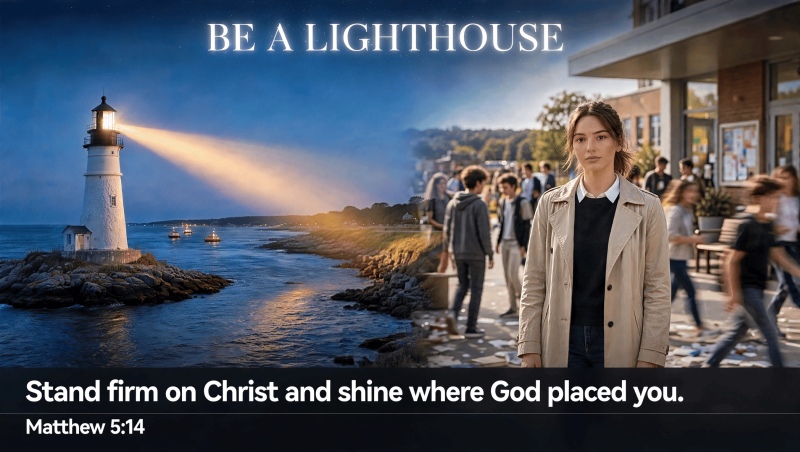
10. Lighthouse Sermon Illustration – Standing Firm to Guide Others
Nature illustration
A lighthouse does not run after ships to save them. It stands firm on the rock, keeps its light burning, and lets the ships find safe passage by its light. Its strength is not in chasing, but in standing and shining.
Human illustration
We often think we must chase people to change them. But influence often works the other way. When we stand firm on Christ and keep our light burning in one place – at work, at home, at school – others find their way around dangers because of us.
Spiritual truth
God calls us to be a lighthouse, not a searchlight. Faithful presence on the Rock guides others. Our job is to shine; God’s job is to guide ships home.
Bible text
Matthew 5:14 – “You are the light of the world. A city set on a hill cannot be hidden.”
Related texts: Psalm 18:2; Philippians 2:15
Sermon takeaway
You don’t have to chase to influence – stand firm on Christ and shine where God placed you.
Reflection
Where has God placed me as a lighthouse today?
11. Walking in the Light Sermon Illustration – Fellowship and Cleansing
Nature illustration
Walking in daylight is different from stepping into light for a second. Walking means staying in it, moving forward in it, letting it show you every next step, every crack, every obstacle. You cannot walk in the light while hiding something in the dark.
Human illustration
Many step into light on Sunday but walk in darkness Monday to Saturday. John says walking in the light is continuous – it brings fellowship with God and with each other, because nothing is hidden.
Spiritual truth
Walking in the light is not perfection, it is openness. When we stay in the light, the blood of Jesus keeps cleansing us as we go. Fellowship and forgiveness flow where light is continuous.
Bible text
1 John 1:7 – “If we walk in the light, as He is in the light, we have fellowship with one another, and the blood of Jesus His Son cleanses us from all sin.”
Sermon takeaway
God doesn’t ask for a visit into the light, but a walk in it – honest, continuous, and open.
Reflection
Am I stepping into the light occasionally, or walking in it daily?
12. You Are the Light of the World Sermon Illustration – Matthew 5:14
Nature illustration
A single small light can be seen for miles on a dark night. You don’t need to be a stadium floodlight to be visible. Even a candle in a window tells a traveler someone is home. Darkness cannot hide light; it only makes it more visible.
Human illustration
We think our light is too small to matter – one kind word, one honest act, one quiet prayer. But in a dark workplace, school, or family, small light travels far.
Spiritual truth
Jesus said YOU are the light of the world. He didn’t say you will become light someday. If you are in Christ, you are already light. Your calling is not to become brighter, but to not hide what He already made you.
Bible text
Matthew 5:14,16 – “You are the light of the world. A city set on a hill cannot be hidden… let your light shine before others.”
Sermon takeaway
You are already light in Christ – don’t hide. Small light in great darkness is still unmistakable.
Reflection
Where am I hiding the light God already placed in me?
13. I Am the Light of the World Sermon Illustration – John 8:12
Nature illustration
The moon is called a light in Genesis, but it has no light of its own. The sun is different – it has light in itself. One reflects, the other generates. One borrows, the other is the source.
Human illustration
We are like the moon – we can reflect light, but we cannot generate it. Jesus is like the sun – He has light in Himself. We shine only when we face Him.
Spiritual truth
Jesus didn’t say “I bring light.” He said “I AM the light of the world.” He is not a reflector of God; He IS God, with life and light in Himself. Whoever follows Him will never walk in darkness.
Bible text
John 8:12 – “I am the light of the world. Whoever follows Me will never walk in darkness, but will have the light of life.”
Related texts: John 1:4; John 1:8-9
Sermon takeaway
Jesus is not borrowed light – He is the Source with light in Himself.
Reflection
Am I following a reflection, or following the Source Himself?
14. Let Your Light Shine Sermon Illustration – Matthew 5:16
Nature illustration
Light has two choices – to shine or to be covered. A lamp under a basket is still burning, but no one benefits. Take the basket off, and the same flame lights the whole room.
Human illustration
Many believers are burning but covered – by fear of what others think, by busyness, by comfort. The call is not to try harder to burn, but to remove the basket.
Spiritual truth
Let your light shine is a command of permission. God is saying “Allow who I already made you to be seen.” When you shine, people don’t see you – they see your Father in heaven and give Him glory.
Bible text
Matthew 5:16 – “Let your light shine before others, so that they may see your good works and give glory to your Father who is in heaven.”
Sermon takeaway
Don’t cover what God lit – let it shine so others see the Father.
Reflection
What basket is covering my light today?
15. Sermon Illustrations on Darkness and Light – Why Light Always Wins
Nature illustration
You can darken a bright room by closing curtains, but you cannot brighten a dark room with darkness. Darkness is not a force that overcomes light; it is the absence of light. Bring a candle into a dark warehouse and darkness flees – it doesn’t fight, it leaves.
Human illustration
We fear darkness as if it were stronger. But anxiety, cynicism, hatred, addiction – they are dark rooms, not dark powers. One act of light – truth, love, honesty – and darkness must leave.
Spiritual truth
John 1:5 says the light shines in the darkness and the darkness has not overcome it. Not “has not yet overcome” but “cannot overcome.” Light always wins because darkness is not a thing, it is a lack.
Bible text
John 1:5 – “The light shines in the darkness, and the darkness has not overcome it.”
Related texts: Isaiah 9:2; John 8:12
Sermon takeaway
You don’t fight darkness with darkness – you bring light.
Reflection
What dark room in my life needs one candle of truth today?
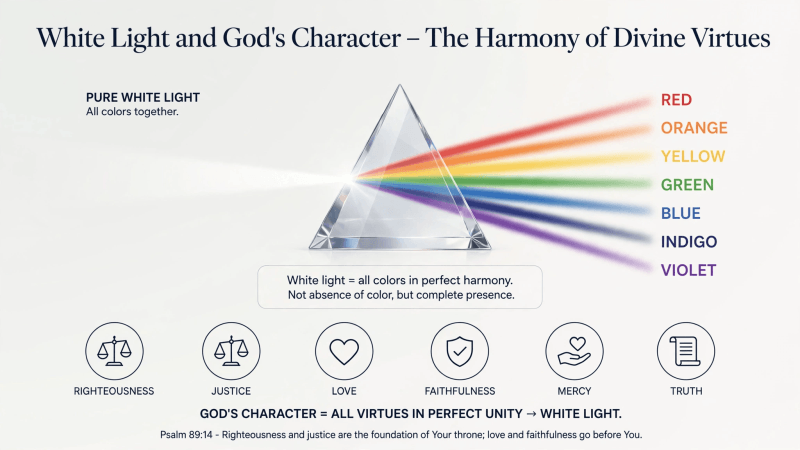
16. White Light and God’s Character – The Harmony of Divine Virtues
Nature illustration
When you pass pure white light through a prism, it separates into every color of the spectrum – red, orange, yellow, green, blue, indigo, and violet. None of these colors are created by the prism; they were already present, perfectly blended in harmony. White light is not the absence of color, but the complete presence of all colors in perfect balance. If you remove one color, the light is no longer truly white.
Spiritual truth
The same is true of God’s character. Scripture never presents God as only love, only justice, only truth, or only mercy. Psalm 89:14 says, “Righteousness and justice are the foundation of Your throne; love and faithfulness go before You.” These attributes do not compete; they coexist in perfect unity. We often want a God who is only loving without being just, or only merciful without being truthful, but that would be like wanting white light with only one color – it is no longer true light. A God who is all love without justice is not good, and a God who is all justice without love is not redemptive.
Bible text
Psalm 89:14 – “Righteousness and justice are the foundation of Your throne; love and faithfulness go before You.”
Sermon takeaway
Immature faith picks one attribute of God and builds everything around it. Mature faith learns to worship God in the full spectrum of who He is. Spiritual growth means reflecting not just one virtue, but the harmony of all virtues – love and truth, justice and mercy, holiness and grace together.
Reflection
Which aspect of God’s balanced character do I tend to ignore? Do I emphasize love at the expense of truth, or truth at the expense of grace? How can I reflect His full spectrum today?
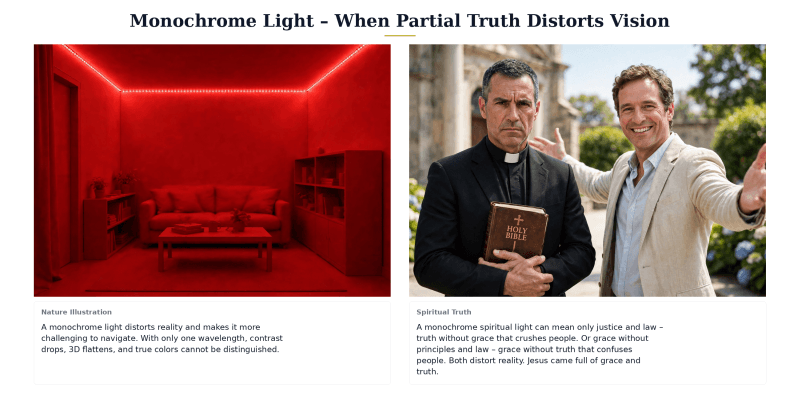
17. Monochrome Light – When Partial Truth Distorts Vision
Nature illustration
If you illuminate a room with only red light, everything looks red. Blue objects appear black, green appears brown, and true colors cannot be distinguished. Photographers know this – monochrome or single-color light flattens reality, removes depth, and makes navigation difficult. You cannot judge what is truly beautiful or dangerous because you lack the full spectrum. The light is real, but it is incomplete, and therefore it distorts.
Spiritual truth
Many Christians live under monochrome spiritual light. Some live under only “truth light” – where everything is about doctrine, correctness, and judgment, but there is no warmth, no grace, no mercy. Others live under only “love light” – where everything is about acceptance and affirmation, but sin is never named and holiness is never pursued. Both are real aspects of God, but alone they distort reality. John describes Jesus as coming “full of grace and truth” – not half of each, but fully both. Truth without grace crushes people. Grace without truth confuses people. Only together do they heal.
Bible text
John 1:14 – “The Word became flesh and made his dwelling among us. We have seen his glory, the glory of the one and only Son, who came from the Father, full of grace and truth.”
Sermon takeaway
Truth and grace are not competitors to be balanced, they are companions that must be integrated. A church that is only true becomes harsh. A church that is only gracious becomes vague. The gospel shines when grace and truth are held together.
Reflection
Have I emphasized one aspect of God’s character at the expense of others? Am I known more for truth or for grace, and how can I grow to reflect both?
18. Growing Beyond Extremes – Living in the Full Light of God
Nature illustration
Those who have grown up under a harsh, judgmental picture of God often swing to the opposite extreme when they discover grace – abandoning holiness altogether. Conversely, those who grew up with a vague, permissive view of God may swing toward harsh legalism when they discover truth. In optics, this is like moving from one extreme color to another without ever finding true white light. You are still living in colored light, just a different color.
Spiritual truth
This pattern of reaction instead of transformation is common. True spiritual maturity does not mean rejecting your past to embrace the opposite, but embracing the full spectrum of God’s light as revealed in Scripture. This requires intentionality. Light does not benefit us accidentally – we must step into it, stay in it, and avoid what blocks it. Ephesians calls us to “live as children of light” – an active, daily choice. Avoiding the light may feel safer for a time, but like a body that avoids sunlight, it leads to weakness and spiritual deficiency.
Bible text
Ephesians 5:8-9 – “For you were once darkness, but now you are light in the Lord. Live as children of light, for the fruit of the light consists in all goodness, righteousness and truth.”
Sermon takeaway
Christian growth is not about reaction – moving from one extreme to the other – but about integration. God wants to produce in us goodness, righteousness, and truth together. That only happens when we intentionally position ourselves in His full light through His Word, prayer, and fellowship, and stop hiding areas of our lives in darkness.
Reflection
Am I reacting against my past instead of being transformed by God’s full light? Which of these three – goodness, righteousness, or truth – needs more intentional focus in my life right now?
19. Unseen Light All Around Us – Trusting God Beyond What We See
Nature illustration
More than half of the light coming from the sun is invisible to the human eye. Infrared light cannot be seen, yet you feel it as warmth on your skin. It surrounds us constantly, reflects off trees and buildings, and even reaches us in deep shade. Plants reflect it strongly – which is why forests feel alive even in shadow. We live bathed in light we cannot see, benefiting from energy that is invisible but entirely real.
Spiritual truth
Scripture says “we live by faith, not by sight.” God’s most important work is often invisible. We look for visible miracles, audible voices, or immediate answers, but God is working through unseen providence, quiet conviction, and sustaining grace. Like infrared light, His presence is not always visible, yet its warmth is unmistakable. You may not see His hand at work, but you feel His comfort, His strength, and His peace upholding you. His absence is not proven by invisibility.
Bible text
2 Corinthians 5:7 – “For we live by faith, not by sight.”
Isaiah 41:10 – “Do not fear, for I am with you… I will uphold you with My righteous right hand.”
Sermon takeaway
We must stop equating God’s presence with visible proof. The question is not “Do I see God working?” but “Do I trust that He is working even when I cannot see it?” Faith grows when we learn to recognize His unseen, warming presence.
Reflection
When have I sensed God’s presence even when I could not see His hand at work? Where do I need to trust His unseen work today?
20. Reflected Light in the Shade – How God Uses Others to Reach Us
Nature illustration
Even when you sit in deep shade on a hot day, you are still receiving light. Scientists have measured that a large portion of the light in shade is not direct sunlight, but light reflected from surrounding greenery, walls, and particles in the air. Invisible infrared wavelengths are especially good at scattering and reflecting, carrying life-giving energy into the darkest corners. Shade is never truly dark because creation itself becomes a reflector.
Spiritual truth
In seasons of spiritual or emotional darkness, when we cannot feel God’s direct light, He often reaches us indirectly – through others. A friend’s encouragement, a sermon, a verse shared at the right moment, an act of kindness – these are reflections of Christ’s light. Jesus said, “You are the light of the world.” Those who live close to Jesus do not produce their own light; they reflect His. Like the moon that shines in the night because it faces the sun, believers can carry God’s light into someone else’s shadow.
Bible text
Matthew 5:14,16 – “You are the light of the world… let your light shine before others, that they may see your good deeds and glorify your Father in heaven.”
Sermon takeaway
God often chooses to shine His light into dark places through the faithful presence of His people. You may be the only reflection of Jesus someone in darkness will see today.
Reflection
Who has reflected God’s light into my darkness? And how can I intentionally reflect His light into someone else’s shadows today?
21. Light That Strengthens and Protects – God’s Quiet, Preventative Care
Nature illustration
We tend to think of light only as illumination – something that helps us see. But biologists have discovered that infrared light does far more. It penetrates deep into our cells and triggers production of melatonin inside our mitochondria – the cell’s energy factories. There it acts as a powerful antioxidant, shielding cells from damage, strengthening energy production, and protecting us long before we feel sick. Its protection is quiet, internal, and preventative.
Spiritual truth
We often thank God for rescue after danger, but rarely for protection from danger we never saw. Psalm 121 says, “The Lord will keep you from all harm – He will watch over your life.” Much of God’s care is like that infrared effect – unseen, cellular, preventative. He strengthens us internally, guards our steps, closes doors, whispers warnings, and builds resilience before the crisis comes. Like light that strengthens the body without us noticing, God’s grace is working in us long before we recognize it.
Bible text
Psalm 121:7-8 – “The Lord will keep you from all harm—He will watch over your life; the Lord will watch over your coming and going both now and forevermore.”
Sermon takeaway
Do not measure God’s care only by the problems He removes after they appear. Much of His greatest care is in the problems He prevented, the strength He quietly built, and the harm you never experienced because He was watching.
Reflection
How has God protected me in ways I may not have noticed at the time? What current “quiet strengthening” might He be doing in me right now?
22. Made for the Full Light – Why Modern Life Blocks What We Need Most
Nature illustration
The human body was designed to thrive under the full spectrum of sunlight, including invisible infrared wavelengths. Yet modern life has moved us indoors. We spend 90% of our lives inside. And even when we are near light, modern double-glazed windows block up to 90% of infrared light, while old single-pane windows let it pass freely. We are surrounded by light, yet starved of the deeper wavelengths that bring vitality. We have more artificial light than any generation, but less exposure to life-giving light.
Spiritual truth
The same is true spiritually. We have more information, more sermons, more Christian content than ever – but we are often blocked from the deeper, transforming light of God’s presence. Busyness, distraction, endless scrolling, and constant noise act like modern windows – they let in visible, measurable activity, but filter out the unseen light that transforms the soul. God says in 2 Corinthians 4:6, “God… made His light shine in our hearts.” That light requires exposure – daily, intentional time in His presence, not just information about Him.
Bible text
John 8:12 – “I am the light of the world. Whoever follows me will never walk in darkness, but will have the light of life.”
2 Corinthians 4:6 – “For God, who said, ‘Let light shine out of darkness,’ made his light shine in our hearts.”
Sermon takeaway
You cannot flourish spiritually if you are constantly indoors – spiritually speaking. Modern life filters out what we need most. Vitality comes from daily, intentional exposure to the full light of Christ, not just artificial substitutes.
Reflection
What “modern windows” – busyness, screens, distraction – are blocking my exposure to God’s deeper light? What practical step can I take to step back into His full light today?

23. Darkness at Noon – Trusting God When Light Unexpectedly Fades
Nature illustration
At noon – when the sun should be at its strongest and the day at its brightest – darkness fell over the whole land during Jesus’ crucifixion. For three hours, at the peak of the day, there was unnatural darkness. Astronomically, this should not have happened. It was a physical sign of a profound spiritual reality: the Light of the world was entering the deepest darkness for us. Even nature responded when the Creator suffered.
Spiritual truth
This is often how our own trials feel – darkness at noon. Not darkness at night, when we expect it, but darkness when life should be bright: a diagnosis during a season of success, a conflict in a good marriage, anxiety in the middle of blessing. Darkness in bright seasons feels disorienting and makes us question whether God has withdrawn. But the cross teaches us the opposite – the darkest moment was actually the moment of greatest redemption. God was not absent in the darkness; He was accomplishing His greatest work in it.
Bible text
Luke 23:44 – “It was now about the sixth hour, and darkness came over the whole land until the ninth hour.”
John 3:19 – “Light has come into the world, but people loved darkness instead of light.”
Sermon takeaway
Faith is not proven by never experiencing darkness, but by trusting God when light fades unexpectedly. The darkness at noon was not the end of the story – resurrection morning was coming.
Reflection
Have I experienced “darkness at noon” – a dark season in what should have been a bright time? How does the cross reshape how I view that darkness?
24. Light That Changes Us – From Illumination to Transformation
Nature illustration
Recent studies in environmental psychology have shown something remarkable: exposure to natural bright light not only helps us see better, it changes how we behave. People exposed to bright, natural light are more likely to act generously, fairly, and honestly. Light does not merely illuminate what is there; over time, it reshapes who we are. Prolonged darkness makes us hide; prolonged light makes us open.
Spiritual truth
This is the final purpose of God’s light. He does not shine His light merely to expose sin – though it does – but to transform character. Ephesians says, “the fruit of the light consists in all goodness, righteousness and truth.” Goodness is love in action. Righteousness is justice lived out. Truth is honesty before God and others. Walking in God’s light over time does not leave us the same. Like Moses whose face shone after being in God’s presence, we become more like what we behold. Transformation is not instant, but it is inevitable when we stay in the light.
Bible text
Ephesians 5:8-9 – “For you were once darkness, but now you are light in the Lord. Live as children of light, for the fruit of the light consists in all goodness, righteousness and truth.”
Sermon takeaway
Don’t seek God’s light only for guidance; seek it for transformation. God’s light does more than show you the path – it changes you as you walk it, producing goodness, righteousness, and truth over time.
Reflection
How has God’s light already transformed me in the last year? Where do I still need His light to produce more goodness, righteousness, and truth?
25. The Morning Star – Hope That Shines Before Dawn
Nature illustration
The morning star – actually the planet Venus – does not shine in the middle of the day. It shines while it is still dark, just before dawn. Sailors have used it for millennia as a sign that night is ending and a new day is certain. It does not remove the night instantly, but it guarantees that morning is coming. Its light is a promise that darkness will not last forever.
Spiritual truth
Peter calls Scripture “a light shining in a dark place, until the day dawns and the morning star rises in your hearts.” Jesus calls Himself “the bright Morning Star” in Revelation 22:16 – linking the very first words of creation, “Let there be light,” to the very last promise of Scripture. God often does not remove our night immediately, but He gives us a light that promises dawn is coming. Our hope is not sustained by changing circumstances, but by a Person who is Himself the guarantee of a new day. Because Jesus rose, we know our night will end.
Bible text
2 Peter 1:19 – “You will do well to pay attention to it, as to a light shining in a dark place, until the day dawns and the morning star rises in your hearts.”
Revelation 22:16 – “I am the Root and the Offspring of David, and the bright Morning Star.”
Sermon takeaway
God gives hope not by instantly removing darkness, but by giving a light that assures us dawn is certain. Our future is as secure as the sunrise because Christ, the Morning Star, has risen.
Reflection
What promise of God can be my “morning star” in my current night? How can I keep the hope of eternity alive while it is still dark?
Conclusion
These sermon illustrations about light offer a rich way to connect God’s Word with the world He created. By observing the sun, sunlight, sunflowers, the sunrise, and even unseen light, we gain insights into His character, His guidance, and His transforming power. Whether you’re a pastor preparing a sermon, a teacher crafting a devotional, or someone seeking fresh sermon ideas for personal reflection, these examples can inspire deeper understanding and practical application. May they help you point others to Christ—the Light of the World—and encourage hearts to walk in His light every day.
If you need more information about the various sermon illustrations, I have written several articles about spiritual lessons from light and the sun.
Resources:
Infographic: 4 Spiritual Lessons From the Sunflower
A 2560 × 1441 HD infographic (PNG file) with four spiritual lessons from the sunflower, along with a discussion & devotional guide.